Software-as-a-Service: Fuelling the SaaS revolution
No matter who you are, the industry you’re in and what you do all day, you’re probably using Software-as-a-Service.
Think of the tools you use to get your job done: Salesforce? Wordpress? Zendesk? Slack? Zoom? Xero? In fact, is any of your software not SaaS?
Over the past quarter-century, SaaS has undergone a transformation almost unparalleled, morphing from something viewed with suspicion to something so normalised we don’t even register that we’re using it anymore.
Almost any tech service you can conceive of could be (and probably is) now delivered via SaaS.
And in startupland, that means the emergence of new, specialised tools; tools that address a niche in a market, or solve a problem no one has been able to tackle before. Tools using new technologies in new ways that might not have been possible even a few years ago.
Needless to say, the founders behind these tools are viewing their paths to growth and funding differently, too.
Part 1: Show me the SaaS
SaaS is something almost all businesses use in some form. It’s an acronym most tech folk will be familiar with, and a concept they understand.
But trying to describe what Software-as-a-Service actually means, in a sentence or two, is more difficult than you might have thought (honestly, try it – it’s weird.)
So here goes:
SaaS is the term for when a software product is provided to a company, usually (but not always) via a subscription, operated and managed by the third-party provider.
Customers get the benefits of the tech, but they don’t install anything onto their own devices, accessing platforms and tools via the internet, logging in on any device.
That means businesses are not responsible for maintaining or updating anything; or for backups, security, development or staffing. They just pay their money and use the product, until they don’t need it anymore.
Of course, this also means businesses themselves don’t own the platforms, and have limited control over functionality and updates, or if something goes wrong.
As we will find out, there are many, many various applications of SaaS technology, but what they have in common is they’re striving to take a problem off their customers' plates; solving something those customers can’t practically solve themselves.
A brief SaaS-tory
The origins of SaaS can be traced way back to the 1960s, with the emergence of ‘time-sharing’ software, which allowed multiple users to access a single computer, each with their own terminals.
With the gradual rise of personal computers, this costly tech largely fell by the wayside. For a time, software was installed on-site in offices, or sold on CDs and loaded on to individual computers.
It wasn’t until the 90s – and the early days of the internet – that it became feasible (and often cheaper for providers) to sell software products online, via web-based applications.
In 1999, Salesforce was founded, truly heralding the era of cloud-based business solutions, with its tagline: “The End of Software."
As the internet rose to absolute dominance, we saw marketplaces emerging, bringing online payments with them. Then came remote servers and software hosted ‘in the cloud’.
In the early 2000s, this was bold new territory, and it was largely small businesses and startups using SaaS. It was considered to be slow, unstable and not safe enough for enterprises to even consider.
But gradually, the tech improved. The early SaaS pioneers grew and grew, becoming modern tech behemoths. Even Microsoft was making SaaS plays, and the benefits were becoming impossible to ignore.
Today, you would be hard pushed to find an organisation that isn’t using some kind of SaaS, somewhere in its operations.
At businesses all over the world, digital natives are rising through the ranks and earning purchasing power. To them, this isn’t new-fangled tech to eye with suspicion. It’s just the way we do things.
And as tech changes march on, we’re arguably still in the early days of the SaaS story.
Why does SaaS work for customers?
SaaS is ubiquitous in modern workplaces, because it’s an appealing model for business. Here are a few reasons why:
Flexibility
Through SaaS subscriptions, decision makers can chop and change, depending on their needs at any given time. Many SaaS providers allow for a level of customisation to meet a company’s specific needs, while various levels of service offerings cater to businesses of all sizes, allowing them to level-up as they grow.
Equally, if a service isn’t working for a team, SaaS services are much easier to cut loose, quickly.
Security
It used to be considered more risky to keep your data off-site. But today, that attitude has almost completely reversed. Most SaaS businesses will use the likes of Microsoft Azure or Amazon Web Services to host their data – some of the biggest names in the tech world, ever, and organisations that take security ridiculously seriously.
If the options are to store data on site, under the watchful eye of one local IT pro, or have it safeguarded by some of the world’s most reputable tech giants, in most cases, it’s a no-brainer.
Lower cost base
With that comes the lower cost base of SaaS. Through software subscriptions, businesses don’t have to pay their own teams to develop or update software in-house, or to keep servers running and secure.
Yes, the payments are ongoing, but in many cases it means businesses don’t have to invest in a whole dev team themselves, instead focusing their resources on other areas.
Ease of use… and time to focus
Finally, the best SaaS tools are those that are seamless and easy to use; the ones that just work.
It’s a case of letting experts build the tools that meet a business’ needs – tools those businesses would never have built themselves – so that leaders can focus on whatever it is they’re best at.
The SaaS landscape in Australia
A 2020 tech modelling report from Invest Victoria and AlphaBeta suggested that the number of Australian businesses using cloud-based tech and software-on-demand more than tripled in the five years previous.
The report predicted that the Aussie SaaS market will grow by 25% year-on-year until 2030. By then, it will have a market value of about $57 billion – up from $3 billion in 2018.
If these numbers are to be believed, we’re in the midst of a huge growth curve that’s showing no signs of slowing.
Indeed, some of Australia’s most successful (and most funded) startups fall into the SaaS category, including Employment Hero, Safety Culture, Expert360, Culture Amp and even Canva.
It’s also a hot space for VC investments, with major funds such as Blackbird Ventures, Airtree Ventures and Square Peg Capital all actively backing SaaS startups.
Part 2: Startups bringing the SaaS
Tractor also has more than a few SaaS companies in its roster (more than we’ve been able to profile here). The SaaS startups in the Tractor family range from construction tech to prop-tech to tools for improving workplace communication.
Some founders are fuelling growth flexibly, through a combination of debt and equity funding. Others are bootstrapped, and plan to stay that way for the time being.
They’re in various different segments and stages of growth; they have different approaches to running, and funding, their businesses.
One thing all these founders have in common, though, is that they wouldn’t run their business any other way.

Float
After spending most of his career working in creative agencies of all shapes and sizes, Float co-founder and CEO Glenn Rogers set out to tackle one of the most pertinent annoyances in the sector: spreadsheets.
In agencies all over the world, project allocation and schedules were being managed via spreadsheets that weren’t collaborative or accessible, and that often resulted in employees being allocated to projects misaligned to their skillsets.
Worse, people were often over-assigned, and left with unmanageable workloads.
Back in 2012, Glenn could see more and more cloud-based tech coming into the market, and he saw an opportunity to solve the problem once and for all.
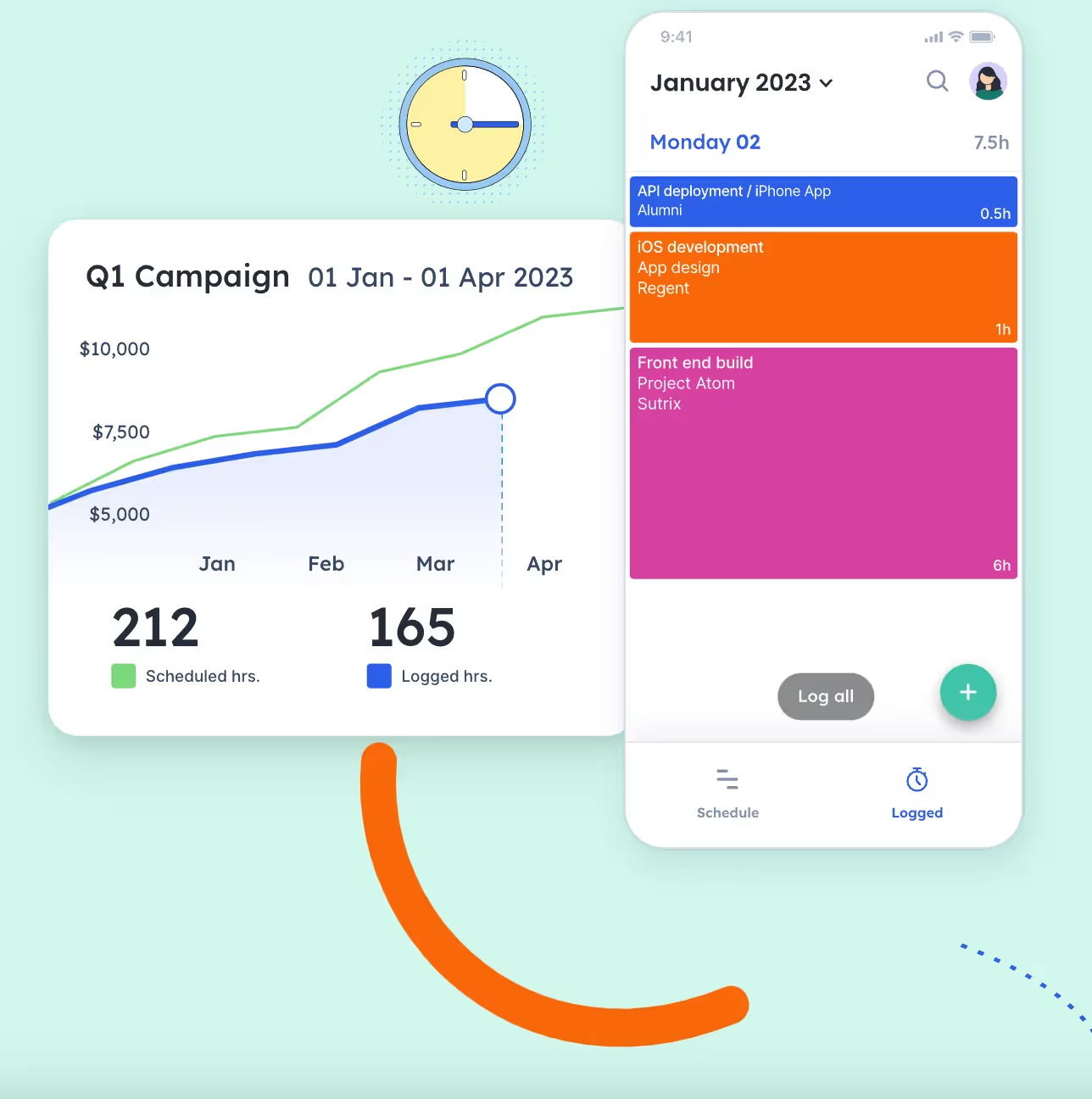
Float is a SaaS tool that allows for collaboration in resourcing, and better visibility of a team’s capacity. It helps teams plan more efficiently and make the most out of their time, and ensures no employees are consistently overstretched.
The startup has been entirely bootstrapped so far, and recently hit the milestone of $10 million in annual recurring revenue.
It wasn’t that Glenn and co-founder Lars Gelfan shirked ‘traditional’ startup capital from day one. In the early days, they applied for accelerators and sought seed funding, but didn’t have much luck.
Glenn invested his own cash to get a product up and running that was good enough to sell, and used that revenue to fund growth going forward. And it worked.
“That to us was enticing – we could dictate our own narrative, define our own way forward. That was contagious, and led to where we are today.”
For Glenn, there’s a simplicity to the SaaS business model that’s endlessly appealing, he says.
“There’s a value exchange. You like the value we’re offering, you hand over your credit card, and we get that cash in the bank at the end of the month.”
Find out more about Float here: www.float.com
Shotstack
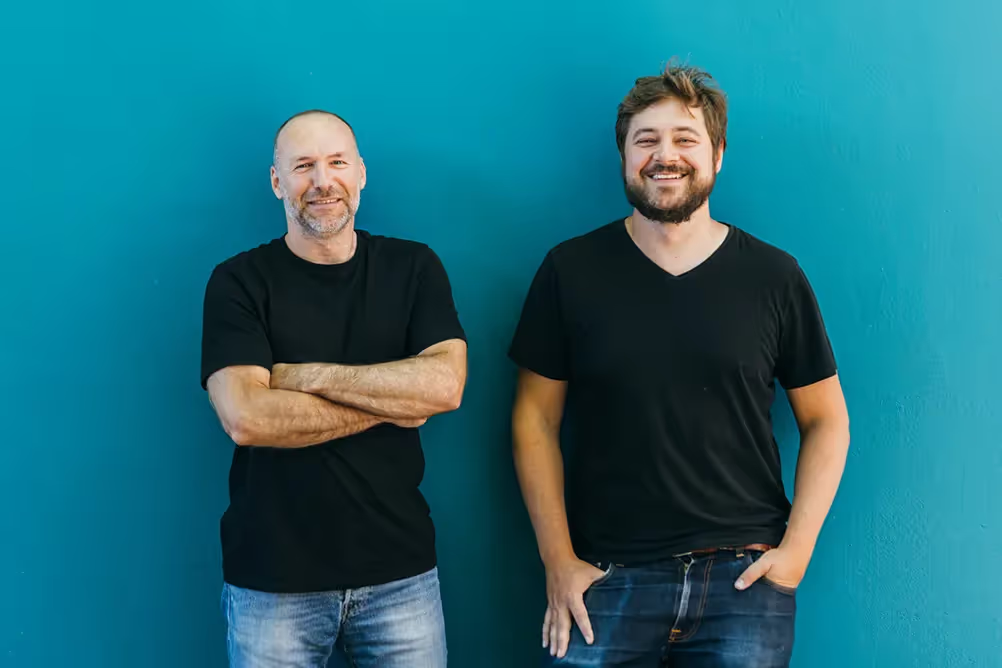
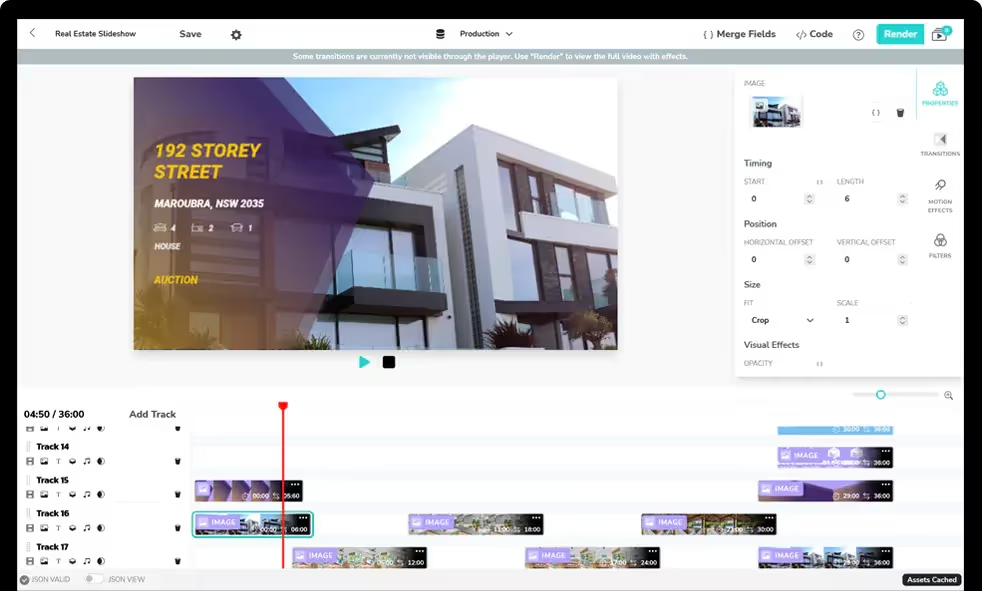
Headed up by co-founders Derk Zomer and Jeff Shillitto, Shotstack is a video automation platform giving businesses the power to create large libraries of personalised videos in a matter of minutes.
A software engineer by trade, Derk was an early employee of Uber in Australia, helping support the ride-sharing behemoth’s launch into the country.
It was here he first realised the power of an application planning interface (API) model.
At the time, Uber was starting to use Twilio, an API allowing text messages to be sent directly to drivers’ phones, via the app.
You could select one driver to contact, or message a whole group. One day, Derk recalls, an employee accidentally sent a text to every driver in the world – then, at least hundreds of thousands.
It was obviously a major error. But for Derk it highlighted an opportunity: APIs could be hugely beneficial for businesses, with a very lucrative business model.
“What it led to was a massive bill from Twilio,” he says.
“That really showed me the power of APIs. It’s quite powerful to have a third-party service that delivers exceptional value like that.
“They’re not part of a marketing expense line item or op-ex, but they’re part of the cost of goods sold.”
Elsewhere, Jeff was working on an AI video editor for filmmakers in the action sports space. It was here that he first built the API that would become Shotstack.
After seeing demand from marketing agencies using personalised video within campaigns, he pivoted to focus on the B2B market, instead of B2C.
Since Derk and Jeff joined forces to launch and scale Shotstack in its current form, the business has grown by 200% to 300%, year-on-year. For the first couple of years, that was without any outside financing at all.
“We’ve been able to do quite a bit with very little,” Derk says.
Find out more about Shotstack here: shotstack.io
.avif)
Teamgage
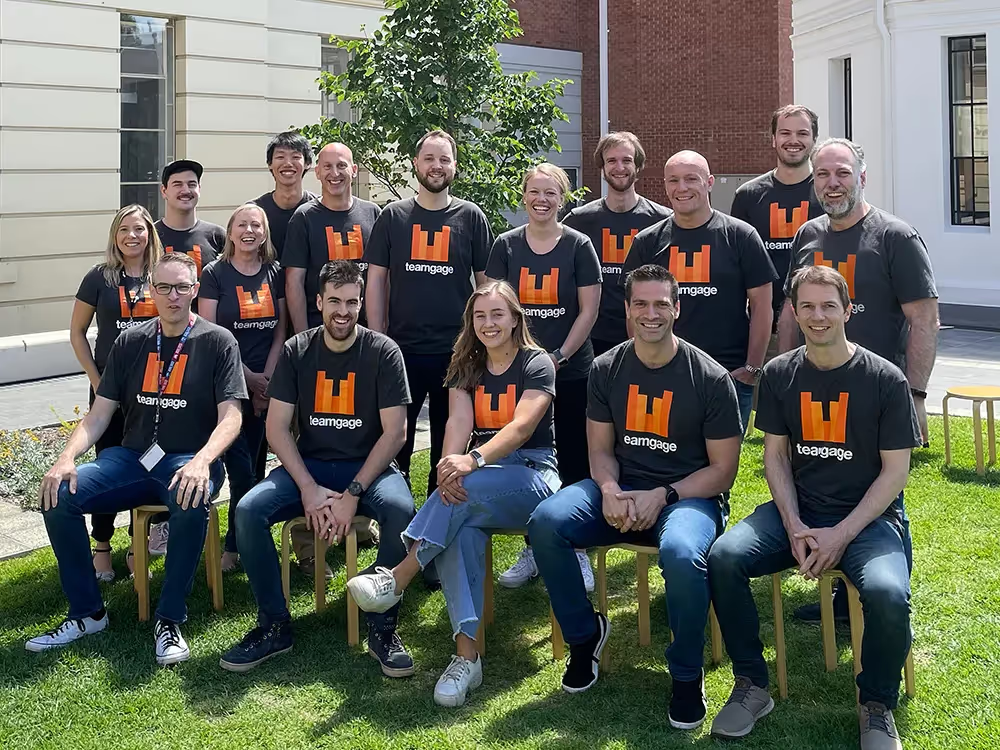
Both Noelle Smit and her co-founder / husband Ben Smit experienced working in ‘good’ jobs, with well-known international brands, and in teams made up of decent people.
For both of them, the experience was far from ‘good’. Both faced challenges around culture and engagement, and, as Noelle explains, when she left, it became clear the regional manager of her employer had no idea what had been going on.
“He said if he had known now things were done, he would have done something about it,” she recalls.
“That was a very pivotal moment. How come he didn’t know?”
Noelle and Ben founded Teamgage to address this very issue, helping team members and employees stay on the same page, and providing visibility without confrontation – ultimately ensuring better experiences for everyone.
The pair never considered anything other than a SaaS model, Noelle explains. After all, this was not their first rodeo.
The first business they built provided software helping universities manage non-academic student activities. Initially, they built the product for one customer. Then that customer asked for more features.
The natural evolution was for the founders to keep the IP and code base, and for the customer to pay for a subscription to that. Other subscribers would then help fund the additional development.
Almost accidentally, Ben and Noelle were SaaS pioneers.
“We got into SaaS really early, back in 2006. It was a new business model and the cloud was very new.
“It turned out to be such a good business model and it worked so well, we didn’t even consider anything else for Teamgage.”
Find out more about Teamgage here: teamgage.com

SignOnSite
Alexandria Garlan is co-founder and CEO of construction site management startup SignOnSite.
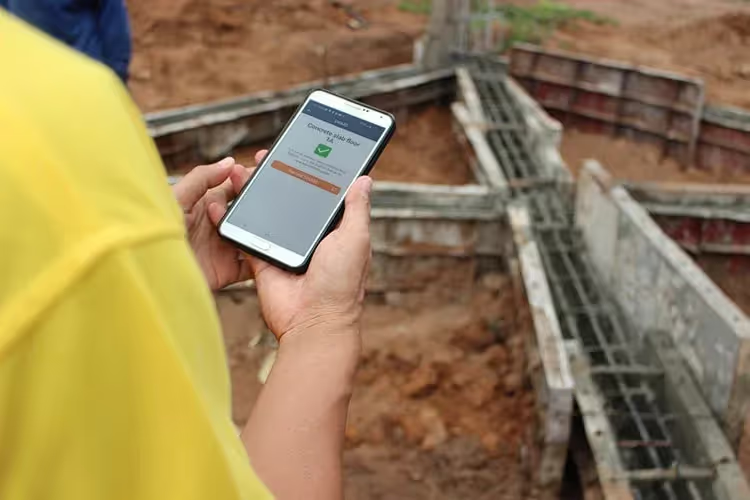
The business launched some ten years ago, with tech allowing tradies to digitally check into their worksite, saving on time and paperwork, helping them avoid hefty fines, and ensuring safety on site.
Since then, it has evolved to digitise and streamline all kinds of manual processes, while also providing key data to site managers and head offices.
SignOnSite is a B2B SaaS startup, in that it sells access to software to other businesses. But Alexandria says she doesn't necessarily identify that way.
Standard SaaS models don’t tend to work well in construction tech, because this industry is still in the early stages of its digital adoption.
“What we deal with, unfortunately, in construction, is an industry that doesn’t know how to buy technology particularly well,” Alexandria explains.
“There are a few industry leaders that have picked it up over the years, but ultimately they don’t have technology procurement principles, and they don’t have internal change management very often.”
SaaS in the constriction space is more “people-heavy,” she adds. Where other corporations might have change managers to work on implementing new SaaS tools (or a tech savvy workforce for whom adopting new software comes as second nature), Alexandria says bringing new tech into construction isn’t a smooth process just yet.
That said, she notes that safety managers are “often innately very strong change managers” – something that bodes well for tech that can have a meaningful impact.
And times are changing, even in this most traditional of industries.
“Where we see the future of construction sites is way more hands off, as companies get more accustomed to purchasing, as they get better change principles internally, and as they understand change management as it relates to head offices and site offices as distinct areas.”
Find out more about SignOnSite here: www.signonsite.com

Social Status
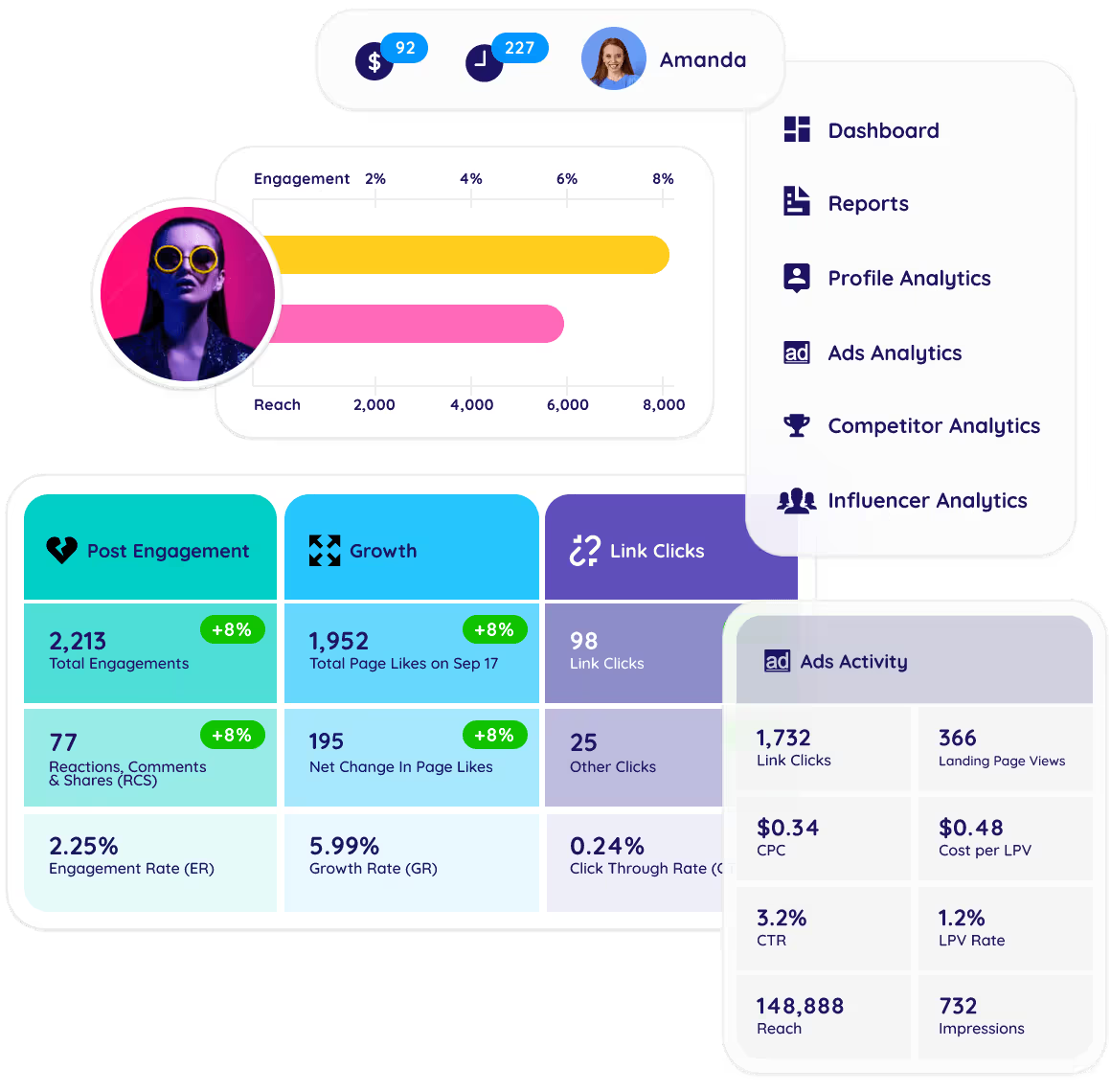
Social Status co-founder and CEO Tim Hill is another former agency man, who built a tool to meet his own needs – namely, reporting on the performance of clients’ social media strategies.
“There were tools on the market at that stage,” he recalls.
“But not really any that go down to the level of depth that Social Status does.”
Tim founded Social Status back in 2013, and ran it as a side hustle for two years or so. Then, he raised some angel funding, “and we’ve been growing ever since."
Today, the platform boasts more than 30,000 users all over the world. It offers flexible, clear and easy to use metrics across all the major social media platforms, allowing for mid-campaign tracking, benchmarking and historical data, as well as benchmarking of organic and paid impressions.
It offers marketers a way to prove ROI, as easily as possible. To offer a service like this, for Tim, SaaS was the only method that made sense.
“It works because it is inherently quite a self-serve function,” he says.
“If you’re a social media manager, or if you're in a social agency or a digital agency, a lot of the time you just want an output – a pdf of last month that compares all of their social accounts, for example.
“That’s really hard to do manually. It’s not impossible, but it’s really time-consuming.”
But for a lot of Social Status users, that need is temporary. They might have a basic requirement, ongoing, but want to ramp up their analysis for a big pitch or end-of-year client meeting.
“They can upgrade into a much more powerful plan, and after the pitch downgrade back,” Tim explains.
“What’s great for the end customer is flexibility.”
Find out more about Social Status here: www.socialstatus.io
%20-%20Justin%20Butterworth.avif)
Snug
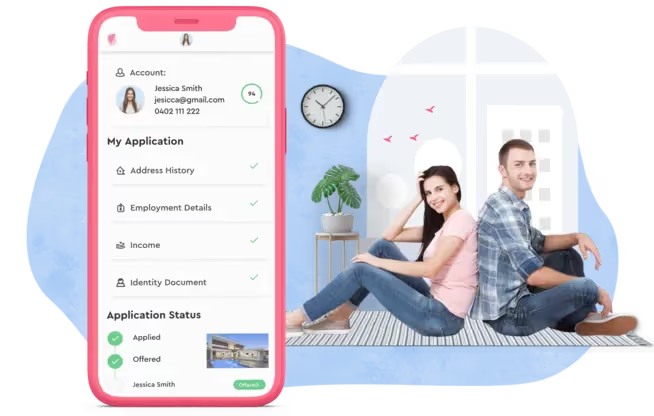
Headed up by serial entrepreneur (and Airbnb influencer) Justin Butterworth, Snug is a real estate platform designed to offer a seamless and secure application process for rentals, helping tenants secure a home faster, and keeping them informed along the way.
The SaaS solution is currently used by some 2,000 real estate agents and 1.5 million renters – a number that’s growing by about 100,000 every month.
For Justin, however, the long-term mission is to create an alternative to ‘traditional’ home ownership, through a diversified and professionally managed real estate investment trust.
“We believe that the next generation thinks of access to the experience rather than ownership of the asset,” he explains.
“So we’re unbundling homeownership to create ‘home’ through better renting and longer leases, to create a sense of security, stability and affordability.”
Founded in 2017, Snug is not Justin’s first proptech endeavour.
Way back in 1999, as he puts it: “I looked out of the window and thought, ‘gee, the internet is going to be big."
It was the year before the Sydney Olympics, and the millions of tourists heading to his city sparked an idea. He sold the home he owned and threw everything he had into his first startup – Rentahome.com.au.
The platform offered online access to short-term rentals, with an instant booking system. And if that sounds familiar, you might not be surprised to hear that the startup featured in Airbnb’s first pitch deck in 2009, as an example of a UX that worked.
Rentahome sold to Fairfax in 2011, for just over $29 million.
Justin stayed with the business through various other mergers and iterations until 2015, when he took a well-deserved year off. But it wasn’t long before the cogs were turning again.
“I could see housing was Australia’s biggest problem, behind climate,” he explains.
“I had the domain expertise, the connections, the capital, and capacity to come back for my second startup, and to make it purpose driven – solving the housing problems that Australia faces by creating a new model of housing that’s accessible, inclusive, stable and affordable.”
Find out more about Snug here: snug.com
Case Study: Culture Amp
One of the startups leading Australia’s SaaS success is Culture Amp, which in its simplest terms (and in founder Didier Elzinga’s own words), is ‘software to help scale culture’.
Founded in Melbourne in 2009, Culture Amp started out as a platform allowing businesses to measure and benchmark employee engagement and satisfaction through anonymous surveys, highlighting where improvements to culture could be made.
The goal was – and remains – to foster a positive and collaborative working environment, and an engaged workforce. Ultimately, that leads to more productivity, a culture of innovation, and better business performance.
That goal resonated with businesses of all shapes and sizes, in Australia and overseas.
As a SaaS business with a vastly scalable and globally-applicable model, Culture Amp has had its sights set internationally from day one. According to Austrade.gov.au, overseas sales now make up about 80% of business.
Today, Culture Amp is used by about 6,500 companies all over the world, ranging from fellow local unicorn Canva to McDonalds to Tiffany & Co, Oracle and even the NBA.
Its survey tools now reach some 25 million workers.
The platform has evolved to offer data analytics, employee development programs, workshops and community initiatives.
In August 2023, Culture Amp announced it is introducing generative AI capabilities, including to summarise survey results into key topics and actionable insights.
Of course, this is also a startup that has resonated with investors, raising a total of more than $400 million in venture capital, to date.
Most recently, it closed a $135 million Series F round in 2021, giving it a massive $2 billion valuation.
Find out more about Culture Amp here: www.cultureamp.com

Part 3: An evolving landscape - and the challenges therein.
In a fast-evolving tech landscape, SaaS is up there with ecommerce as one of the sectors most quickly changing as new technology becomes available, and as consumers become accustomed to it.
Many of these SaaS businesses are using tech that just wasn’t available (at least, commercially and at scale) until relatively recently.
For example, Shotstack’s Derk notes that he and Jeff wouldn’t have been able to launch their startup ten years ago, simply because of the computing power it requires.
The tech evolution is also driving a change in attitudes in large businesses, and building trust in software solutions.
In the past, ‘enterprise SaaS’ wasn’t really a thing, Derk suggests. Large businesses wanted and needed their tech on-premise for security or connectivity reasons, or simply because they were “a bit archaic”.
For some large enterprises, that is still the case. But trusted tech giants like Amazon and Microsoft are adding more and more SaaS solutions, and individuals are becoming more used to using SaaS and subscription products both in their personal and professional lives.
“The opportunity continues to grow, because more companies are switching to SaaS-based services,” Derk says.

Teamgage founder Noelle has witnesses that change first-hand. In their first business, she and Ben were selling to some of the largest enterprise customers around – universities.
“You had lots of hoops to jump through to land a sale with them,” she recalls.
In a time predating AWS, the businesses used Microsoft Azure Cloud Hosting.
“I remember having to prove to people why that was trustworthy. Today, you just say ‘we’re hosted on Azure’, and there are no more questions asked.”
“It was a different world,” Noelle says. “We’ve certainly seen it evolve.”
So often, timing is key in startupland. In SaaS, we’re seeing a convergence of tech readiness and market readiness.
As Snug’s Justin Butterworth says: “To innovate is one thing. To execute and scale is another.”
“Software used to be buy-in-a-box, get the CD from Officeworks, and install. It was a relatively static product."
“The beauty of cloud, our global connectivity, and strong internet connections means that we have the awareness and the understanding – of the benefits as well as the features contained within software solutions – to get access and trial them under freemium models."
“We hear about software, and we can reliably trust using software online as our core business systems."
“The infrastructure that AWS and Google Cloud have rolled out have given the world confidence to become SaaS-enabled, and pioneers have created comprehensive, reliable software platforms in the cloud."
“Businesses have enjoyed the productivity, the efficiency gains, the incredible innovation that can be delivered through an agile development environment, and ongoing releases within a software product."
“And the interoperability of API connections between SaaS products creates a network effect and releases even more business benefit and customer experience."
“So, software in a business has gone from trade conventions and CDs at Officeworks to try-before-you-buy, interconnected, rapidly enhancing and improving software, which is really now the core of any business, small to large.”
- Justin Butterworth, Snug
Key challenges in SaaS
Even in the fizziest of sectors, there are always challenges to be overcome, and the SaaS space is no exception.
These are some of the major issues highlighted by our entrepreneurs:
Keeping it simple
For Social Status, there’s some overlap in the opportunities and the challenges of a SaaS model.
On the one hand, founder Tim explains, the social media sector is becoming ever-more fragmented, with more channels and media types emerging even within individual platforms.
Businesses are experimenting with social media to see what resonates with their audience and what doesn’t, and to figure out where to spend their marketing dollars, Tim says.
“That always represents an opportunity for us to help them make that decision.”
However, more fragmentation means more complex data, and while Social Status offers the tools to deep dive into that data, it also strives for simplicity.
“Our customers tell us they like Social Status because it’s easy to use,” Tim explains.
"Whether you want to stay at the helicopter view and just get summaries, or whether you want to dig into metrics and really interrogate data points, hopefully we have a use case."
“But it’s an inherently challenging thing to do – to continually deliver on a product that’s both simple to use and powerful.”
Pressure to add value
In a similar vein, Teamgage co-founder Noelle notes that with subscription software, there’s an expectation that the product will be continually improving, offering customers more for less.
“Back in the day, as you added more features you could justify price increases,” Noelle explains.
“Now, customers expect the base subscription to include more features each year.”
It brings complexity in terms of managing a larger code-base, training and onboarding to new products, and making the economics work. But with so much software now available on the market, it’s necessary.
“You have to show you’re more valuable, more cost efficient, and solving more problems. That’s new.”
At the same time, Noelle notes that because upfront costs for SaaS subscriptions can be relatively low, businesses are more susceptible to market conditions.
“If people want to tighten their budget, they’ll go through their list of providers and look at which ones they can cut.
“If you’re another kind of business model or product, that’s not always so easy to just switch off.”
Reaching a critical mass
These lower price points also mean businesses have to think about the bigger picture, and how to get a critical mass of users on board, quickly.
As Float founder Glenn notes, bringing in $50 per month from a handful of clients won’t sustain a dev team for very long.
"The hardest challenge for most SaaS is that first $1 million; to get to profitability,” he says.
“You need a lot of customers, and you need to stay alive until you get to a point where you have that critical mass of customers. Because that doesn’t happen overnight.”
Glenn is a big advocate for bootstrapping, fuelling growth through revenue, even when it feels like the longer, harder way around. When you hit that critical mass, it’s worth it, he says.
“But once you have that level of sustainability where the customers are essentially funding your investment, that’s a wonderful thing.”
Reaching your customers
Finally, the B2B nature of many SaaS startups means it can be harder to get in front of those critical customers in the first place. Alas, productivity tools seldom make for good dinner-table conversation or influencer content.
In fact, as Social Status founder Tim has found, users are more likely to consider their SaaS tools as ‘secret weapons’, ie, not something they shout about where their competitors might hear.
Social Status also offers white-labelling, meaning an agency can be using the product, and the end client would never know.
“In that situation, inherently, word of mouth is kind of suppressed,” Tim explains.
“You’re not likely to talk about your workflow and the tools that you use. You’re much more likely to take ownership of the end outcome.”
According to LinkedIn, there are just over 1 million social media managers in the world, not including digital marketing managers, digital strategists and the like.
Social Status has on boarded about 30,000 users, “so we’ve got a long way to go”, Tim says.
“With marketers, you’ve really got to earn their trust – and that’s good. They should second-guess everything. It comes with the territory.”
Part 4: How to fund SaaS
For all the same reasons SaaS appeals to entrepreneurs and customers, it appeals to investors, too. You don’t have to look far to find venture-backed SaaS businesses that have seen monumental success – think Employment Hero, GO1 and (of course) OG Australian tech darling Atlassian.
The draw isn’t only the potential for cost-efficient scalability. As this Forbes article notes, SaaS startups allow for relatively easy forecasting, low barriers to adoption for customers, and almost universal performance metrics, all of which offer an element of predictability in an industry defined by risk.
However, just because SaaS is well suited to VC, doesn’t mean VC is well suited to all SaaS.
Some of the businesses we’ve profiled here haven’t taken on any equity funding at all. Others have used a combination of equity and debt funding, at different times, depending on the stage their business is at. As is often the case, an elastic approach to capital is often the best one.
“In our space, our mission is transformative, not disruptive,” Snug’s Justin Butterworth explains.
“Once we had our initial venture capital to bring the idea to life, we used venture debt to scale the idea.
“It just delivers great ROI and is non-dilutive. It’s infinitely more capital-efficient.”
Small-scale SaaS
The reality is that most SaaS startups offer a very specific service to a relatively small market. Not every business aspires to be a Culture Amp or Employment Hero, and nor should they.
“A lot of SaaS businesses are happy to operate in a niche and make a profit, and build defensibility. Then they might make a private equity play in the future,” Shotstack founder Derk says.
“There are still not a lot of options open to that early stage."
“You either have to be willing to grow with the means that you have in a small market and be happy you’re hitting $1 million and that being the cap, or you need to find funding in some way, shape or form to go beyond that.”
When Social Status raised in 2016, founder Tim wasn’t really aware of debt funding for startups as a concept. The expectation, he says, was that you would raise some kind of equity funding to fuel your early growth.
He did just that, but it took time and energy, and took him away from actually building the business.
“If you think about why you’re raising capital, a lot of the founders will say it’s to move faster,” Tim says.
“You’re pulling that capital in so that you can invest in things today that would have organically maybe taken a year to get to.”
Tim sees Tractor’s funding model as the epitome of this. It’s a relatively small chunk of capital to help hit a milestone, allowing for more organic growth; an amount small enough that it might not warrant all the effort of raising VC.
“Increasingly, more traditional venture capital doesn’t seem to fit anymore with SaaS,” Tim says.
“That might be a little bit controversial, but I feel like VC money is much more for the moonshots. It’s for the startups that need tens of millions or hundreds of millions of dollars, because they’re building something that’s so far out of where current activity is.
“For your typical SaaS – not that it’s not interesting – it’s just a different dynamic.”
“A lot of tools that I hear of being used by our customers are smaller tools that are best-in-class. They’re built by smaller teams, so their cost base is lower."
“They’ve still got great opportunities to build great businesses – high cash-flow businesses – but actually, even if they were able to raise millions of dollars, could they actually deploy that capital really well? Probably not. It’s probably not the kind of capital they need."
“In some angel conversations I’ve had, people have said I’m not raising enough."
“I’m trying to raise a few hundred thousand, and they’re saying I should raise $2 million. I don’t think I could deploy that smartly. I would just be kind of burning it."
“As a SaaS business, we could scale up and do all that stuff, but you’re suddenly chasing revenues so far ahead of you that you’re almost set up to fail."
“It’s quite counterintuitive to say actually, no we don’t want to raise a lot because it’s going to create a problem for us once we’ve burned through that capital."
“It’s a bonkers conversation.”
- Tim Hill, Social Status
Recurring revenue as an asset
As SignOnSite’s Alexandria explains, there’s another element to funding SaaS that’s unique to the model: the potential for annual contracts. More often than not, payments will still be monthly, but that’s still guaranteed revenue moving forward.
If you can encourage a one-off annual payment, all the better. For Alexandria, combining this cash-flow with debt can be very powerful.
“Say you’re a founder-led business, you’ve got OK sales, you’re doing annual upfront payments, and you bring on someone to do your go-to-market through debt."
“You can move a few of your customers to multi-year upfront, with a discount, to give your go-to-market person a few months of extra advertising."
“You have raised no equity funding to do that, but you have achieved a new hire, and you’ve given them resourcing to be successful in their role."
“If you’re selling widgets for $6 each, that might not be an option. If you’re selling a monthly subscription for $15, that might not be an option. But if you’re doing annual, upfront payments for $10,000 or $20,000, that’s possible. And that’s doable in SaaS.”
- Alexandria Garlan, SignOnSite
Teamgage founder Noelle also sees recurring revenue as an asset – but one that’s not usually recognised on the balance sheet.
Again, this makes debt an attractive option. Of course contracts need to be renewed, but even a conservatively low estimate would put renewal rates at about 70%, and a downturn would almost always be slow and gradual, rather than happening overnight.
“There’s a revenue and a capital base in our businesses by nature that doesn’t get recognised in traditional accounting methods,” Noelle says.
“But, like in any business, you should be able to leverage your assets for growth, and I think debt funding allows that, specifically the Tractor model, which looks at your ARR as a key indicator of your ability to pay back a loan.”
Weighing up the cost of capital
As always, there’s no one right path to capital for every SaaS startup.
For Float’s Glenn, the key thing to consider is finding the right kind of capital – the capital that suits the business and the founder best (and it might not be external capital at all). Even more crucial is to understand what that capital will cost.
“Every exchange you do with VC or debt funding is a partnership. You’re entering into an agreement with expectations,” he says.
"With debt, you’re paying in interest. With equity, there’s equity, as well as potentially board seats and governance, plus the time taken to complete a round. Even grants and government subsidies come with stipulations."
“You want to be really clear on what you’re giving up in each of those agreements. You need to figure out what you’re willing to give up as part of that exchange.”
Part 5: What does the future of SaaS look like?
Today, there are more tools available than ever, giving people everything they need to build a SaaS business, without having to write a line of code.
In just a few years, the barrier to entry has been significantly lowered. That might mean an increase in competition, but it also levels the playing field, allowing more diverse products, from more diverse founders, into the market.
This phenomenon also allows entrepreneurs to quickly build an MVP, meaning they can demonstrate product-market fit to investors, fast.
“You can build a SaaS business overnight if you wanted to,” Derk says.
“That type of business will be incredibly easy to set up and potentially scale, if that’s what you want.”
At the same time, Glenn believes we’re past the era of the cliche SaaS startup – the startup that raises millions upon million at huge valuations, just to downsize when the market takes a turn.
"The past two years have been “probably the hardest economic environment I’ve felt”, Glenn says.
But startups are coming out the other side of it with more sustainable businesses, and founders are looking for a path to profitability.
“It’s wonderful to see the industry evolve into something more sustainable, more capital-efficient, and better for employees that join SaaS startups – so they’re not caught up in these hire-and-fire cycles."
“I hope that’s a good thing. While it’s been an incredibly tough two years, there have been some good, hard lessons and some welcome corrections to what was going on."
“The pendulum swings. But I think we’re in a really healthy space right now.”
Fragmentation vs consolidation
In terms of more specific trends, Social Status founder Tim expects to see something of an expansion in the landscape. Instead of large companies offering all-in-one tools with a suite of functionalities, he predicts an “unbundling."
Customers are looking for best-in-class tools that do one thing, and do it well. So instead of having one subscription to a large platform, they will have multiple subscriptions to multiple, specialised solutions.
“They will complain about it,” Tim predicts.
“They will want one tool to do everything. But they just need to do what they need to do, and I think it’s unreasonable to think one tool can be the Swiss army knife.”
But not all SaaS is created equal, and in the construction space at least, Alexandria expects almost the exact opposite to happen.
Within the next ten years, she’s predicting a consolidation.
“There are a lot of point solutions in the market, so we’ll see one or two companies coming out that will be really strong platform players, that integrate with lots of things, and sort of gobble up all the smaller service offerings,” she says.
She points to the likes of Hubspot and Salesforce, which have acquired companies and added features and solutions on an ongoing basis. They just keep getting bigger.
This is something we haven’t yet seen in construction tech.
“For us, it’s about making sure that our platform is the best one out there, in terms of user experience and in terms of achieving our customers’ goals, and then making sure that everybody can get the information that they want out of our platform, rather than anybody else’s.”
Artificial intelligence in SaaS
In any discussion about tech trends, artificial intelligence is sure to raise its head – and it’s something almost all of our founders highlighted as something they’re keeping an eye on.
“It’s changing the game,” Glenn says.
AI won’t dramatically change Float, how it works or what it looks like. But in terms of how Glenn and the team can draw insights from large amounts of customer data, and action those to help solve problems, “it’s just remarkable”, the founder says.
Glenn describes himself as “a tech optimist”. For him, the future means using AI to build faster and more efficient services and operations, ultimately providing a better service to customers.
“Three years ago I was distilling large volumes of spreadsheets manually, and spending a good part of my day just doing that,” he says.
“I can now take that and summarise it in seconds, so I can get on with actually actioning some of the feedback."
“It’s not jobs lost, it’s about doing more effective value creation.”
Snug founder Justin also sees AI as the number one opportunity for SaaS over the next few years. He expects to see software creeping into everything from analysis to creative work to problem solving and risk mitigation – with more interoperability allowing data to flow throughout a business.
But it should also be treated with caution and respect, he says.
“It’s quite phenomenal the potential of AI to take SaaS businesses to the next level."
“What comes with it is immense ethical responsibility, radical transparency, discussions of equity, equality for those that have access to digital systems or not, and transparency around decision-making."
“And importantly, human oversight and intervention to ensure human outcomes."
“In SaaS, AI is the black swan moment. It’s the incredible transformation of the sector. But with it come some interesting and challenging aspects for SaaS operators and their customers.”
- Justin Butterworth, Snug
AI will undoubtedly bring new opportunities and new risk – and that will cause a huge shift in the market.
As always, Teamgage founder Noelle says, that means there will be winners and losers.
The SaaS businesses that survive will be the ones that continue to focus on the customers, their needs, and adding real value.
“We’re all trying to ride that wave and stay relevant, and make sure the use case is relevant to the customer – not just chase AI for the buzz of it.”
Noelle predicts that novelty AI tools that don’t actually make life easier for end users will fall by the wayside, and fast.
“Museums of technology are full of tech that seemed cool at the time but has no real-world application."
“That’s obviously not the case with AI and generative AI, but in each of our individual SaaS products we have to find where it’s actually going to create more customer value as opposed to adding complexity without value.”
Arguably, this has always been the way with SaaS – and with any business for that matter. It’s about understanding your customers’ needs or pain points, and solving them in a seamless way."
“That’s always been the model,” Noelle says.
“It’s just that now you’re using different tech to solve the pain points than we were before.”

Writer