There is no one ‘correct’ road to startupland, and not every tech business is built out of a garage.
We’re seeing more and more startups sprouting from existing companies, with employees or business owners taking their skills and expertise and spinning them out into brand new businesses.
Specifically, there’s a small but growing community of entrepreneurs that have taken their experiences building or working in agencies to create new products that are in themselves commercialisable – and highly scalable.
The agency-to-product route isn’t exactly a traditional way to build a startup, and it’s not a well trodden path. But it is a highly interesting one (and most definitely to the team at Tractor Ventures!)
These are founders that have truly deep experience of the problems they’re solving – often niche, complex problems that those outside of their space would know even exist, let alone think to tackle.
Part One: Agency vs Product; what’s the difference?
Agencies and product-based businesses require fundamentally different business models. An agency will complete work for its clients on a project-by-project basis, running advertising campaigns or building bespoke products, for example.
They’re paid for the hours worked or services delivered, and once a project is complete, they’ll move onto the next.
Product-based businesses, specifically those offering Software-as-a-Service (SaaS) products, own their tech and sell that to their customers, often via a subscription model rather than as a one-off.
They’re focused on one piece of tech to address a common problem for as many customers as possible.
Agencies sell services, skills and expertise. Product-based startups sell specific, purpose-built tools, created with the benefit of those same skills and expertise.
Perhaps the most crucial difference, however, is scalability. In an agency, capacity for customers is directly linked to manpower; the amount of clients a business can take on depends on how many people they have to work with them.
For product-based businesses, once the tech is up and running, it can be rolled out on a broad scale much more quickly.
As a business grows it may need additional development or customer services staff, but the numbers of staff don’t have to increase at the same ratio to the number of customers.
In an article for Forbes, SaaS founder and one-time agency man Jesse Schoberg said agencies are easy to start, but hard to scale. While product-led businesses are harder to launch, and quicker (if not easier) to scale.
Once a product starts gaining traction, founders are much more likely to see that hockey-stick growth curve that startups dream of. Then, the possibilities are almost limitless.
Why switch from an agency model?
The agency model spans many sectors, with businesses typically supporting other businesses in their branding and growth goals. They’re businesses utilising their industry expertise and contacts to help other businesses succeed.
Some of the key types of agencies include: advertising, marketing and branding; design; digital services; media; public relations; and recruitment.
In each of these sectors, there are limitations to the agency business model.
Agencies rely on the expertise of their team, which not only limits expansion horizons but can leave them vulnerable when key staff members move on. Hiring and training new staff to provide the level of service clients expect can be time-consuming and costly.
At the same time, agencies provide important services to their clients, but not necessarily business-critical ones. When times get tough, their services are easy to drop. The same risk applies if a new competitor emerges with a more tailored solution.
Creating a product can remove some of these limitations, allowing more potential for scale, and the prospect of becoming indispensable to clients.
But that’s not the only reason entrepreneurs might want to make a change.

Gavin Ballard and Victoria Beal are the co-founders of Disco Labs, a successful agency business building custom software for merchants in the Shopify eCommerce ecosystem.
They built their product Submarine in-house, and are now in the final stages of winding down the agency, to focus on growing as a product-based startup.
Agency life is “feast or famine”, Gavin says.
“You’re constantly having to find the next client or the next project. You’re working hard to deliver something on a timeline, then moving onto the next thing without having time to polish and refine it.”
Building a product-based business allows the founders to build something of their own; something they have a little more control over. For Gavin, that’s largely what drove the shift.
“It’s your vision being pushed out there, rather than something a client wants you to do.”
What are the risks?
Making any big pivot comes with risk. If you’re shutting down something successful in favour of a relative unknown, those risks are pretty self-explanatory: if the new venture doesn’t take off, you’ve got nothing to fall back on.
There’s also the question of how to fund a pivot. Using revenue from the original business means pausing any development and growth there. Taking on equity investment can lead to more pressure and quicker timelines, while debt means – well – debt.
For many founders, a major pivot can lead to disruption and upset among staff members. Founders have to consider how to empower them and bring them on the journey – or how to handle things if some roles are no longer required.
Change management is key here. Dissatisfied employees can lead to lower productivity, reduced creativity and a sour atmosphere in general – none of which is good for innovation.
As we will see, it’s possible to mitigate these risks by building and launching a product while continuing to run the original agency, iterating as you go to give the spin-out more chance of success.
Some founders have focused on gathering as much feedback and customer direction as possible before taking the leap, meaning they can be relatively sure there's a demand for what they’re offering.
One founder, however, made a clean break almost overnight, taking on maximum risk for a change he believed in wholeheartedly – and he hasn’t looked back.
Part Two: Seven Agency to Product Founder stories
These seven companies have all made the shift from agency life to a more startup-like product-based model, and they’ve all taken slightly different routes to get there.

1. Submarine
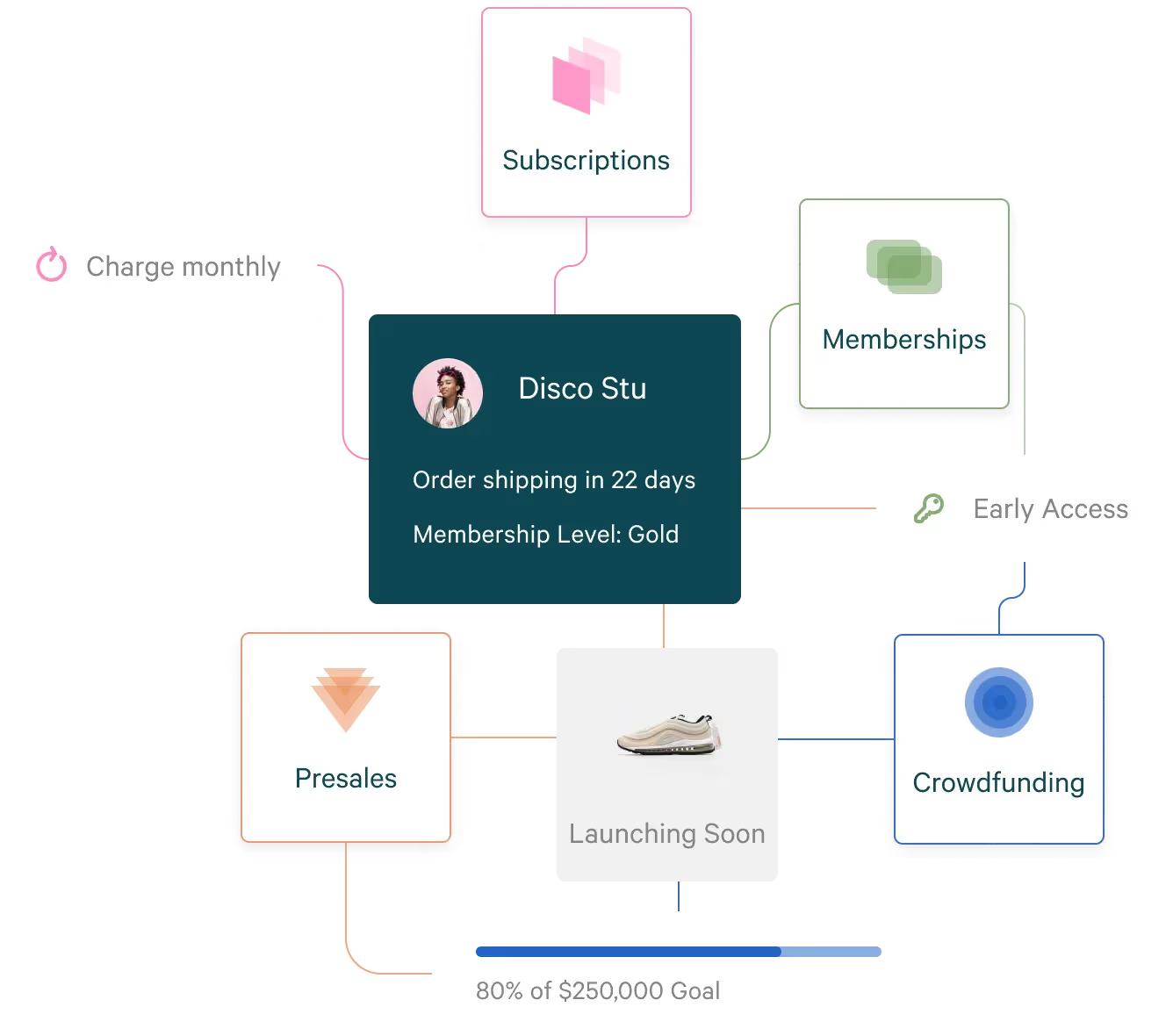
Submarine was built out of Disco Labs, an agency working in the Shopify ecosystem to build custom software and integrations for large merchants – tools allowing for things like subscription sales, pre-sales, crowdfunding, and anything else that goes beyond the traditional one-time transaction.
The tech tool packages up all these capabilities into a product for other agencies, boosting the services they can offer their own clients.
It’s been a gradual shift, and the founders say they’re now about 90% of the way through the pivot process.
As Victoria says, there was an element of risk here – and we’ll go into more detail later on how exactly the founders approached the transition.
But for her, it was exactly the right time to take that risk.
It’s becoming more common for agencies to specialise in a particular ecosystem or tech stack, she says. It’s easier than ever to spin out products and plug them straight in.
She and Gavin were intimately familiar with this ecosystem, and the challenges facing merchants within it, she explains.
“They're basically coming to you saying there's a gap in the market."
“Maybe they come to you with a pain point and you know the perfect product. But, but if you've got clients coming to you consistently asking for custom solutions or to find a way around a particular problem, it's kind of staring you in the face.”

2. Float
Float is a prime example of a product-based startup built by people who have spent years deeply embedded in agency life – long enough to identify a chronic challenge within it.
Co-Founder Glenn Rogers spent a decade working in advertising agencies of all shapes and sizes, in Australia and New York. Everywhere, there were projects to manage and people being allocated to them – and whether the agency had ten employees or hundreds, the solution was the same: spreadsheets.
“You could see the pain points; you could see the problems that were occurring,” Glenn explains.
“People were being over-scheduled and people were unclear of their allocations on projects – and a spreadsheet isn’t a very collaborative tool.”
At the time, more and more tools were shifting to the cloud – and Glenn saw an opportunity here. He reached out to a technical director he knew, Lars Gelfan, who he quickly brought on board as a Co-Founder.
Float seeks to oust spreadsheets from agency resourcing, offering clear resource allocation and more collaboration, and ensuring people are assigned projects that best suit their skills, without going over their capacity.
For two years, Glenn and Lars built the startup as a side-hustle, working on it in evenings and weekends before going all in.
Float has now been bootstrapped for 12 years and counting, and recently hit the milestone of $10 million in annual recurring revenue.

3. The Jacky Winter Group and Immortality Projects
Headed up by Jeremy Wortsman, The Jacky Winter Group started out as a fairly straightforward talent agency representing artists, illustrators, animators and designers. Over 17 years, it’s grown and shape-shifted, working in partnership with other agencies, and expanding to offer B&Bs, artist retreats and even a gallery.
Though Jacky Winter is not a funded Tractor company, their impact on the Australian creative space by facilitating a space for creatives to grow their business opportunities via collaborations with brands of all sizes, has been hugely significant.
And they're a shining example of an agency thinking outside the confines of 'the business of agencies.'
From day one, tech has played a key role in Jacky Winter, Jeremy says. But it has always been important to him to build key software in-house – software that solves unique problems for artists and creators.
“That didn’t come from a place of us wanting to make money, we just really like building things, and like the idea of owning things and making an end-to-end experience,” he says.
“As soon as you leverage someone else's product, you’re kind of at their mercy from a brand and functionality perspective.”
During the COVID-19 pandemic, the whole team shifted to remote work and these online tools had to be made available online. Suddenly it made sense to sell them as standalone products – and so the spinout business of Immortality Projects was born.
Immortality Projects’ flagship product is Cobbler, an end-to-end SaaS for talent agencies and creative studios, designed to help them scale while managing their clients and commissions fairly.
Within Jacky Winter, it’s been around for some 16 years.
Spinning Cobbler out into a white-label SaaS product was something Jeremy had always considered. But without the pandemic forcing his hand, he's not sure it would ever have happened.
“We were forced to make something web-based,” he says.
“But there would have been no reason for it otherwise.”

4. Amplified Intelligence
Dr Karen Nelson-Field’s journey from agency to product is unusual to say the least. In fact, the launch of Amplified Intelligence followed an early career in corporate advertising and marketing, and ten years in academia.
Even as an agency, the business was built not on industry experience, but on deep, deep expertise in the field.
As an academic, Karen attracted global attention for her research into new media and attention measurement.
At the time, the likes of Facebook and YouTube were emerging as the new tech titans, and ringing in a new era of online marketing. But what they were selling to marketers was untested at best, and in some cases completely off-the-mark.
“I was the first person ever to look at whether ‘likes’ really matter,” Karen explains.
Back in 2012, Karen's paper on whether Facebook ‘likes’ equal brand engagement (spoiler: they don’t) cast doubt on the social media giant’s entire advertising model, and threatened to derail its IPO.
This led her to start looking into viewability, and the amount of time people spend on content – or, as Karen puts it: “Bullshit metrics that mean nothing."
Through academic research, Karen was discovering that the metrics used to track the success of online content were all wrong.
“There are all these flow-on effects that happen in an entire ecosystem that not many people understand. But I did.”
Karen left academia to launch Amplified Intelligence, and essentially created the category of attention measurement, as opposed to impression measurement.
She’s written two books on the subject, and considers herself to be a whistleblower of sorts, sharing her knowledge and empowering marketers to understand what’s meaningful to measure.
“I basically blew the lid on an entire ecosystem, which for 15 years had failed our industry,” she says.
“The entire industry was being – I won’t say defrauded, because it’s not fraud – but ill-informed.”
For four years, Amplified Intelligence operated as a research agency. Karen and her team wrote, lectured and validated, further defining the challenges in this new ecosystem.
Karen's word became gospel, and solutions were being built around it. This is when it became clear there was a product opportunity here.
“We validated this metric for four years – I’m an academic so I wanted to make sure it was real and of value,” she explains.
“But I can’t be a category driver and not capitalise on it.”
Now, Amplified Intelligence provides a solution helping agencies and publishers (including major social media platforms) measure attention and create more effective marketing strategies.
But once an academic, always an academic. Karen is not focused on only one area of measurement or even one static product. There are no half-measures here, and ‘that’ll do’ is not in her vocabulary.
“Because we’re the architects of the ecosystem, how do we focus on making sure this business plays across the ecosystem to play a role in its change?
“We don’t have one product that we’re focusing on, because the ecosystem is a measurement ecosystem, which is very different.”
6. iion
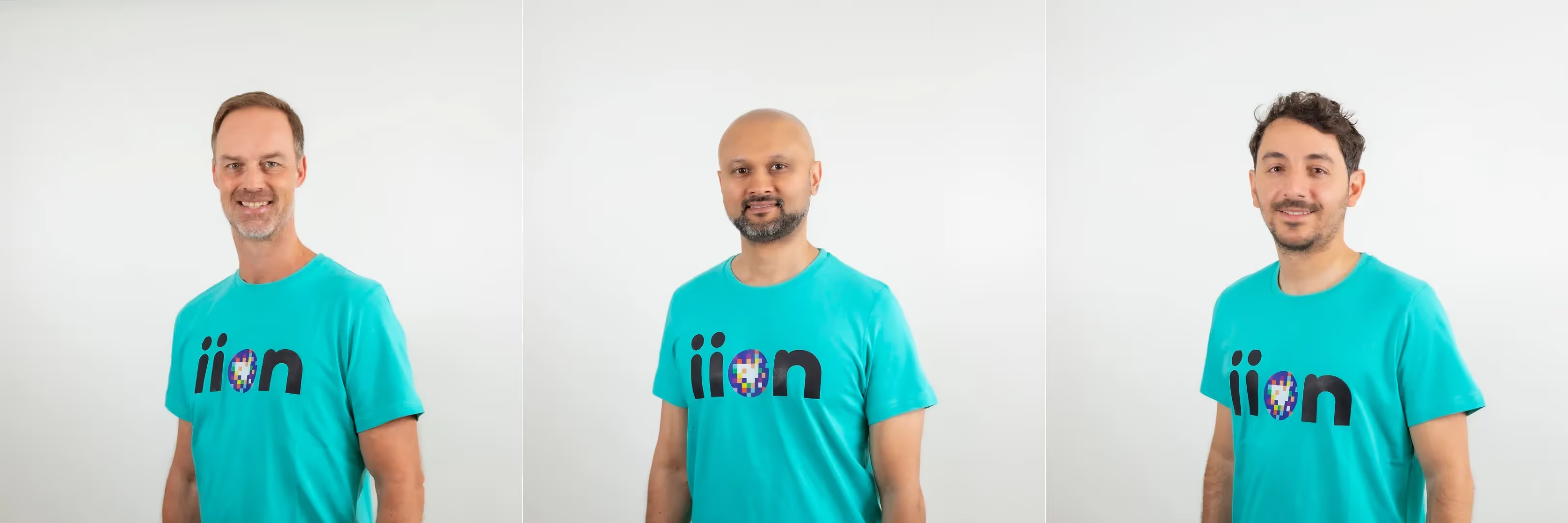
iion co-founders Sanjaya Molligoda and Wout van Damme have been working together in some capacity for almost two decades, running online businesses spanning media, advertising and content, and driving the evolution of programmatic ads.
Having mainly built agency-style and service-based enterprises, and having experienced exits, an ASX listing and selling-then-buying-back their business, the entrepreneurs – along with colleague Giuseppe Martoriello – saw a new, untapped opportunity for monetisation and advertising: gaming.
“We didn’t see enough brand dollars coming into gaming,” Sanjaya explains.
There were three key issues, he says. First, there was “huge” fragmentation across different gaming platforms and environments.
“Brands were finding it very hard to activate gaming as a channel, easily, in one place.”
Second, measurement of success – attention metrics, brand awareness and even fraud prevention – was not up to scratch, compared to other sectors.
And finally, there were challenges on the creative side, too.
“It was very difficult to make engaging creative content that suited the gaming environment.”
Sanjaya, Giuseppe and Wout set out to build a platform that solved all three of those problems, making it much easier for brands to create high-quality ads for various gaming environments, at scale.
Now, they’re working with agencies and developers all over the world, and have access to some 1.1 billion gamers, globally.
It’s a different way of working, compared to what the founders have done previously. And, as Giuseppe notes: “It’s a lot more scalable.”
6. Cartelux
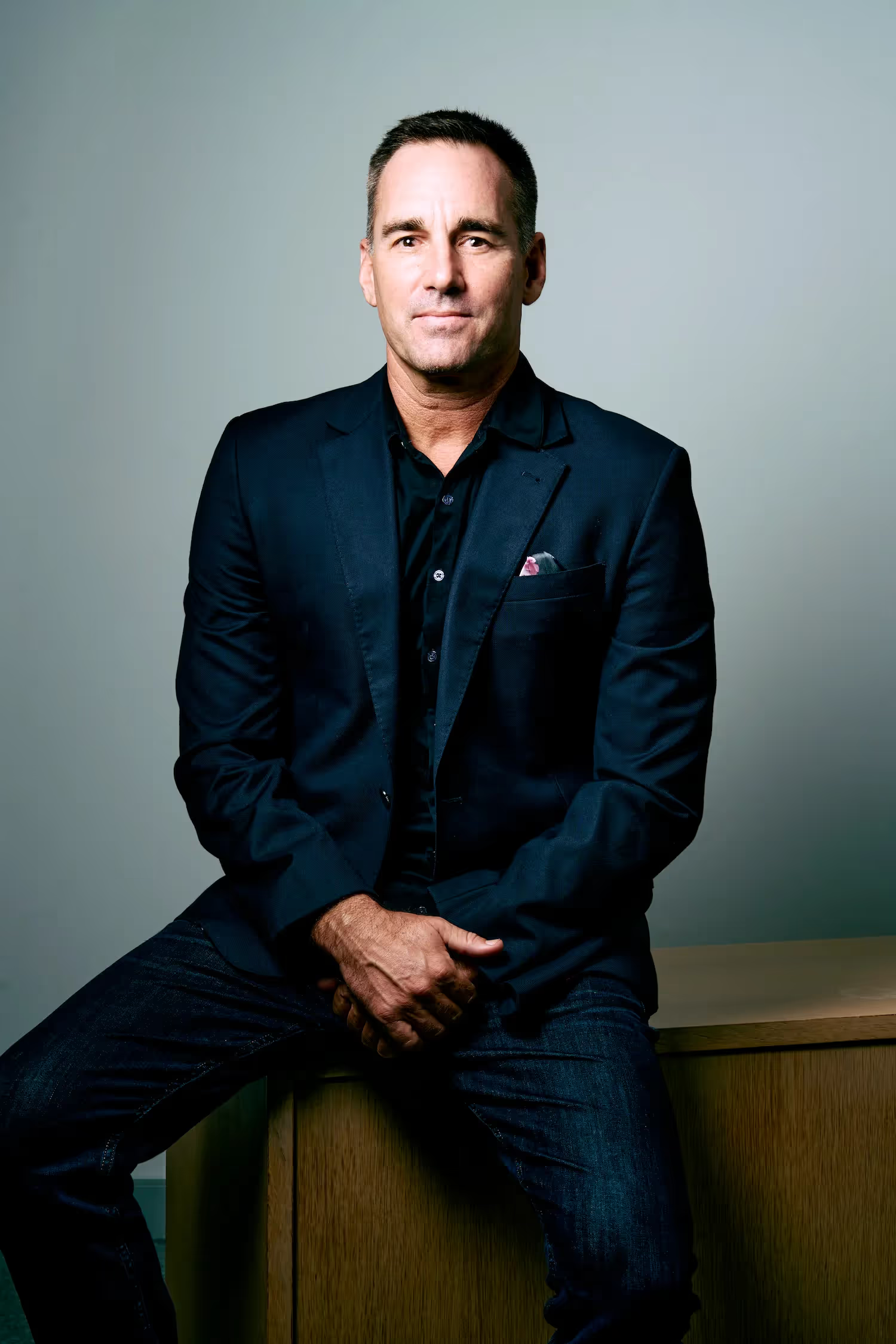
Cartelux founder Joshua Williams took an all-or-nothing approach to his pivot. With a background in advertising and filmmaking, he originally built Cartelux as a media management agency, helping businesses grow through video and creative strategy.
It was successful, bringing in large and high-profile clients from all manner of industries.
However Joshua was hearing about the same pain points and challenges over and over again – and he had an inkling as to how he could tackle them.
In 2018, after six years, the founder shut down the agency business, and re-launched as a SaaS startup.
The Cartelux platform is designed to simplify the process of creating digital and video campaigns, and measuring their impact.
Essentially, Joshua says, all that remained of the original Cartelux was the name.
“We had a very successful business, but it was 100% services, and I just didn’t see an efficient way to scale.
“Most importantly, I had a much better idea for the platform, that would actually solve the problems we were hearing about, at scale.”
Joshua just couldn’t see a way to move forward with both businesses. Providing bespoke services while also building a tech startup was “like oil and water”, he says.
"It would have been way too intense.”
And while he admits an almost-overnight pivot was “a breathtaking gamble”, he hasn’t looked back.
Today, Cartelux works with some of the world’s biggest companies, largely in the automotive space, and it’s growing steadily. Joshua says, even back then, he knew this was the right path to take.
“I bet my whole life, basically, on that decision."
“But I never doubted it for one second.”

7. Avid Collective
Avid Collective wasn’t technically born out of an agency, and it’s not exactly a product-led startup either. It is, however, a tech platform built to solve an agency problem, built by a founder who was in the thick of it.
Originally, Luke Spano was running digital publisher Where To Media. As well as producing pure editorial content, he and the team worked with advertisers and agencies to run native content campaigns – sponsored or branded editorial.
“We kind of uncovered how much fragmentation there was in the space, and how resource-intensive it was for the advertisers,” Luke says.
“We saw there was such a big opportunity to sit in the middle between advertisers and publishers to make the entire industry much more accessible, much more scalable and much more impactful.”
Luke first created a network to facilitate connections between advertisers or agencies and publications – fostering relationships with brands he used to compete with.
Then, it evolved into a platform, and a business in itself.
Where some founders have built agencies or worked within them, then spun out a product-based business to address a familiar pain point, Luke ran a business that worked closely with agencies, identified a problem affecting both ends of that pipeline, and built a platform to remove friction for everyone.
“When we saw the impact that had, in terms of how much easier it was, and how much more efficient our business was, we realised there was a scale opportunity to solve this entire category for the industry.”
Linktree: An agency-to-product success story… and what happened next
Founded by brothers Alex Zaccaria and Anthony Zaccaria, and their friend Nick Humphreys, Linktree is a shining example of an Aussie startup that built a product out of an agency, and saw ridiculous growth, ridiculously fast.
The co-founders originally ran a digital agency focused on music and entertainment, which included managing the Instagram accounts of artists.
At that time – back in 2016 – Instagram only allowed for one link in artists’ bios (and no links on grid posts), and changing it for every artist update was becoming a chore. A change to the algorithm also meant there was no guarantee users would be shown a post that relates to the current link in bio anyway.
The earliest iteration of Linktree was whipped up in six hours, to solve this very specific challenge. As it turns out, millions of Insta users were grappling with the same gripe.
The founders released Linktree to their clients, and soon were getting signups from outside their circle, too. The rest, as they say, is history.
By 2019, Linktree had 2.8 million users. In 2020, that was up to 5 million. In 2021, it was 12 million, and in 2022 it was 24 million.
Today, you can add another 11 million to that.

The startup has also attracted significant funding, raising $150 million in 2022 at a whopping $1.7 billion valuation.
Today, Linktree is more than a link-in-bio tool. It offers Shopify and Square integrations, and support for online creators. But it hasn’t all been smooth sailing on the VC backed journey.
Economic downturns have seen Linktree make layoffs in the local AU&NZ market, and in a recent email to employees which was made public, CEO Alex said Linktree would be growing its product, engineering and marketing teams in the US – where most of its customers are – hiring people with specific knowledge of that market.
“The opportunity for Linktree is immense and I am more determined than ever when making tough calls like these, to make sure we make it count,” he wrote.
“We are still at day one, and the changes today put us in the best position to reach our ambitious vision.
Part Three: How to make a pivot happen
It’s one thing to identify an opportunity for an agency-to-product pivot, and another to make it happen seamlessly and successfully. Disco Labs and Submarine founders Victoria and Gavin are well on their way to doing just that.
As Tractor co-founder and co-CEO Jodie Imam explains, Submarine is a prime example of a business who’s founders identified an innovative way to productise their service offering, but kept getting caught up in servicing their existing clients.
.avif)
By taking Tractor funding, they were able to wean themselves off of that income, refocusing on the thing that would allow the business to scale.
This is just one of many examples where Tractor funding has been a catalyst to change, Jodie says.
“Our funding can really help redirect the energy of a team in order to build the product, in order to build a much more scalable company, which then results in them raising more money, and really growing well.”
With that in mind, we took a deep dive into Submarine's story so far.
A Submarine deep-dive
As an agency, a lot of Disco Labs' business was focused on software development and delivering tech to clients, so moving into product was perhaps less of a leap than for some other agencies.
Submarine was a product they had already built for internal use. It was already generating revenue, and the founders could see there was an opportunity they weren’t taking full advantage of.
Disco Labs also already had an engineering team, working in three-week development cycles, that could be gradually re-deployed.
Elsewhere, one key project manager transitioned into a support and success role, and another became the lead product manager.
“They already knew the space, the company and what we had built to date,” Gavin explains.
No staff members have been made redundant, and no one has left purely because of the pivot. People were moved from agency work to Submarine as the product picked up speed, while agency work slowed and clients were referred elsewhere.
However, for Gavin it hasn’t always felt like a smooth transition.
Initially, the founders tried to allocate 20% of development time to the product, and 80% to the agency, he explains.
“The reality of that was that the client work always took priority."
“It made it really hard to do either well. After years of trying to chip away at the product, it wasn’t at the pace of development that we would need to actually make it successful.”
One of the reasons Gavin and Victoria went down the revenue funding route was to effectively hire themselves. They became their own (and only) clients for a period, flipping the balance of resources to allocate 80% to Submarine and 20% to clients.
They knew the opportunity was there – after all, Submarine was already generating revenue. But still, tipping the scales towards the product was a difficult thing to do.
In hindsight, Victoria says perhaps they shouldn’t have tried to do both for as long as they did.
But, given their time again, she admits that they would probably do the same thing.
“It’s a difficult call, because it’s a scary thing to cut that cord of service work, to no longer be as diversified, and to not be able to take on a bunch of clients.
“I guess it’s about finding that balance between being cautious and taking a risk at the right time.”
A shift in mindset
If you’ve been operating as (or within) an agency for some years, moving to a product-based business model can also require a major shift in mindset. With greater growth opportunities come greater ambition; and that can require a new style of leadership and entrepreneurialism.
As founders, Gavin and Victoria have felt a certain responsibility to keep their employees in the loop. But it’s been a learning curve.
As a product-led business, there is more talk about runway, and what will happen if the startup runs out of cash, Victoria explains.
There’s a balance to be struck, she says, between transparency and respect; empowering employees with information and overloading them unnecessarily.
“It really tests you,” she says.
“If you can start that journey with a team that’s already on board with what you’re doing, then that makes it easier.
“We’re still learning. We’ve got a little bit better at sharing information in a way that’s healthy and honest, but not offloading.”
Victoria is also very aware that Submarine, as a business, is playing in a different space to Disco Labs. Her contemporaries are no longer agencies but startups: fast-growth, innovative, cutting-edge startups.
“Some people have raised an absolutely ridiculous amount of money,” she says.
“You definitely start comparing yourself to businesses that have had more VC interest, or have had what looks like overnight success.”
This creates a kind of insecurity she has never experienced in the agency world, and while her confidence in Submarine has never wavered, it hasn't been easy to navigate.
“It hasn’t changed our values or our approach to clients, customers or partners. I guess it’s just about how the outside world perceives you if you haven’t had that overnight scale.
“The perception of what success looks like in the startup world is so different – it can be exhausting.”
All change
For iion, too, the move to a platform model has led to something of a culture change.
“As a tech company, you have to invest more in tech,” Giuseppe says.
“It might sound obvious, but there are a lot more tech components that you need to think about. You have to work with the tech team and develop a product.
“In the past, we were leveraging tech that was already there. Now we have to focus a lot more on what we build ourselves. What innovations do we bring to the market? How do we make them commercially ready? And so on.”
Now, the founders consider themselves disruptors; they’re having conversations about hockey-stick scaling, three-digit growth and funding. And all of that brings further benefits.
“In the past, when we were more of a service, it wasn’t really sexy,” Giuseppe says.
“Now, because we’re focused on a niche or a particular segment, and we have something disruptive, it’s a lot more attractive for top talent to join us.”
Elsewhere, Jeremy has largely stepped away from the day-to-day running of Jacky Winter, to focus on growing Immortality Projects. For him, it’s almost like going back to square one.
“When you’re managing a large business, you want to make the biggest change with the least amount of effort, so you can have the most impact.”
Jacky Winter had grown to a point where he wasn’t involved with every decision, or every little thing going on in the business, he adds.
“Now, I’m making very, very small changes. It’s really only me, so you get a lot more immediate insight."
It’s not only founders that require a mindset shift. Avid Collective is innovating in a space that has operated in the same way for decades, and competing with very large, legacy media players and agencies alike.
On the one hand, the sector is shifting towards technology and efficiency. On the other, those legacy players are not necessarily investing in tech. They’re set in their ways, and not easily moved, Luke explains.
“That’s why the space is so ripe for disruption,” he says.
“Everyone could operate so much more efficiently, but what you build has to be of really high quality to compete.
“MVPs don’t really cut it in this industry … if your platform is clunky, people are just going to go back to the old ways of working.”
Funding a change
As with any major pivot, there is always the small question of how to fund it.
For some – including Immortality Projects – the original business continues to tick over profitably, funding the spin-off for as long as necessary. Amplified Intelligence have secured VC funding, and fuelled growth via Tractor, while some of our other founders plan to raise at a later date, when it feels right for them and their startup.
Float, on the other hand, is bootstrapped so far, and that’s how Glenn plans to continue for the time being.
For founders building products out of agencies, VC funding doesn’t always feel like an accessible route to them – or one that’s necessarily appealing.
These entrepreneurs are not new to business, and they’re used to operating with a cash-flow-positive mindset. They may also not be ready to give up equity in their business, at least until later in their journey when there’s a little less risk for everyone.
At the same time, some feel their products are perceived as ‘side-projects’, and therefore not always taken seriously by VC investors.
Of course – as is the case for most startups – traditional business loans from the big banks are usually out of the question.
What role does Tractor have to play?
For Gavin and Victoria, it was debt funding from Tractor Ventures that allowed them to gradually tilt the scale from Disco Labs towards Submarine.
Cartelux Founder Joshua has been on a very different journey, and initially funded his abrupt pivot with the help of investment from family and friends who backed his vision.
For him, however, funding from Tractor made “all the difference” in getting the business from early-stage funding to a Series A round. He was able to make some key hires and keep momentum going.
“It was absolutely critical to our journey.”

Cartelux has since been able to prove its model at scale, and has closed a $3 million Series A round, led by Ten13.
iion’s founders hope to follow a similar trajectory. They’ve used Tractor to make the investment needed to scale their platform product, proving that the model works, with a view to raising later at a higher valuation.
As for many startups, debt funding also bridges a cashflow gap. The platform works directly with the supply side, where payment terms are typically 30 days, and with agencies, which are more likely to pay within 60 to 90 days.
“There’s quite a large gap in the middle, where we need to self-fund,” Sanjaya notes.
“When we wanted to really scale the business fast, we needed that extra cash injection – for cash flow and to hire some sales people.”
Finally, it’s not uncommon for founders to put their own money into their ventures – often ‘borrowing’ from their personal savings or even super. When fundraising later, some VCs are reluctant to treat this as debt, insisting that founders do not repay themselves, at least for the time being.
As some of our founders have seen, VCs typically don’t see Tractor funding in the same way. It feels counterintuitive, as one entrepreneur notes, but because of this, debt funding can be highly preferable in the long run.
For Jodie, the key point here is that Tractor funding is suited to all kinds of different businesses and business models – even when you’re in the idle of a shake-up.
“The traditional VC investor will only look at the productised, scalable revenue, and will discount all other revenues,” she explains.
“We consider all revenue and can lend against all revenue, to help businesses get to a point where they can transition into more meaningful, product-based revenue.
“If you have a path to profitability and you can prove it – showing that if a dollar goes in here and more money comes out – that’s the way we fund.
“We want to see more businesses like this, and we want the agency world to understand how to use this to the full advantage.”
Part Four: The power of people
One thing each of the founders interviewed here is the incredibly strong connection they have to the problem their product is solving. They’ve been in their customers' shoes, and they’ve experienced the same complex, niche and incredibly specific challenges.
Float Co-founder Glenn, for example, saw pretty much all agencies grappling with the same challenge. Yet few had tried to solve it in-house.
“It’s a classic agency challenge, in that they’re so busy servicing other clients that very rarely do they look inwards,” he explains.
When you’re busy meeting clients’ needs, it can be hard to down-tools to solve in-house needs, even if that would solve productivity challenges in the long run.
And (in ad agencies at least) websites are in their wheelhouse – software is not.
Float is a tool that had to be built by someone who knew the extent and scale of the problem; someone from the inside.
And now it is used by companies that range from Atlassian to Stripe to Ogilvy to Deloitte, and more. Some 4000+ of them. Some 4000+ teams, in companies, to be specific.
“When you live the problems – particularly those that impact how your time is spent – you get quite passionate about solving them.”
At the same time, according to these founders, the agency environment can set people up for entrepreneurial success.
Agencies are hives of creative, talented and hardworking people – all putting their skills to use to benefit other businesses. It should come as no surprise when they branch out on their own, or embrace an in-house pivot.
Working in a creative agency environment ensures people are often the first to know about new trends and culture shifts, Jeremy says. Agency folk are nothing if not in the know.
“If you have a bit of an entrepreneurial bent to you, that can be very inspiring,” he says.
“You’re seeing and hearing things before the rest of the world is – it gives you a bit of an edge.”
Glenn also sees huge potential for entrepreneurs to grow out of agencies. They’re hubs of collaboration and creativity, with different departments and projects acting almost like mini businesses.
“I learnt much of the fundamentals of building a business from working in an agency with a client and a large budget … you get the diversification, you can work with large clients and small businesses, and how they operate."
“Advertising is a wonderful hotbed to learn from other people and other businesses.”
It’s not only a business that pivots from agency to product, it’s the founders too – founders who have been building up to this, planning, drafting and wondering for their whole careers.
A business model is not for life. There’s no need to choose your route and stick to it if you see another path that might work better for you, or for your customers. People change and grow; entrepreneurs change and grow; and businesses change and grow.
“In entrepreneurship, there’s this bullshit notion that you get this lightning strike idea,” Karen says.
“That’s actually rubbish. The reality is that you get clues all your life.”

Writer